
Manage School Identity, Rosters, Accounts, and Learning Environments from One Local Data Source
Manage school rosters, user accounts, groups, classes, and enrollment information across Microsoft 365 and Google Workspace™ from one locally managed data source.
ClassSync is a Windows application designed for school IT administrators and authorized staff who manage Microsoft 365 and Google Workspace™ environments.
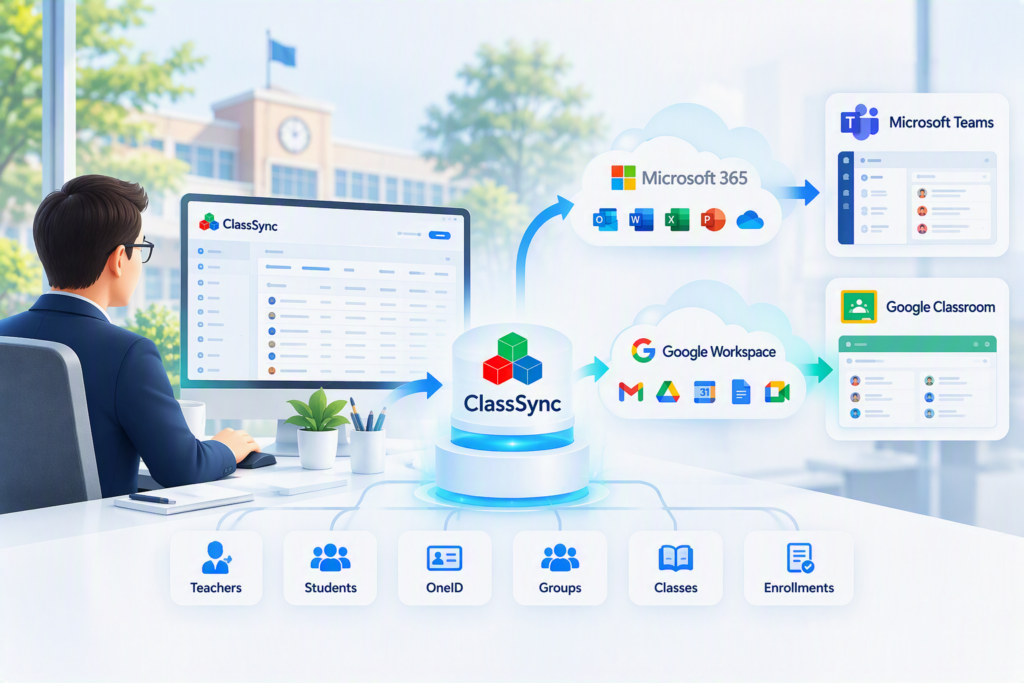
ClassSync brings teacher rosters, student rosters, OneID mappings, course assignments, enrollment rosters, accounts, groups, and class-provisioning workflows into one locally managed school administration environment.
Teacher and student rosters are primarily stored in the local ClassSync database on the administrator’s device rather than in a DONGSEO-operated central roster repository. When an administrator initiates a supported external operation, the information required for that operation is transmitted to the applicable school-managed Microsoft 365 or Google Workspace environment through authorized APIs.
ClassSync is designed to help schools use Microsoft and Google services without requiring another centralized school-roster platform operated by DONGSEO.
Why ClassSync?
Schools increasingly use more than one cloud platform.
Microsoft 365 may be used for identity, collaboration, Microsoft Teams, and School Data Sync, while Google Workspace™ may be used for identity, Google Classroom™, Google Calendar™, and other educational services.
Managing separate user lists, groups, classes, and enrollment information for each platform can result in repetitive administrative work.
ClassSync is designed around a different approach:
Maintain the school’s source data locally, then reuse the same structured school information for supported Microsoft 365 and Google Workspace operations.
For class provisioning, ClassSync converts the applicable locally managed roster, course-assignment, and enrollment information into SDS V2.1 CSV data that can be reused across the supported provisioning paths.
This gives schools a common administration model while allowing Microsoft and Google to continue providing the underlying identity, cloud, collaboration, and learning services.
How ClassSync Manages School Rosters and Accounts
ClassSync uses a locally managed database as the primary source for teacher, student, class, and enrollment information.
Administrators can:
- create teacher and student rosters directly;
- import and export CSV files for bulk editing;
- match roster entries with existing Microsoft 365 or Google Workspace™ accounts;
- create or update supported cloud accounts;
- manage account mappings through OneID;
- create supported groups;
- prepare course assignments and enrollment rosters; and
- use the same underlying school data for supported class-provisioning operations.
ID Matching
ID Matching helps identify existing Microsoft 365 or Google Workspace accounts for roster entries that do not yet have a OneID.
If multiple users have the same name, ClassSync presents the matching results for administrator review instead of automatically selecting one account based only on the matching name.
ID Synchronization
ID Synchronization can use OneID and other required roster information to create supported Microsoft 365 or Google Workspace accounts or update existing account information within the approved permissions.
OneID Management
OneID Management helps administrators manage existing cloud accounts and supported account information such as:
- Microsoft 365 and Google Workspace account mappings;
- account domains;
- Google Workspace organizational units;
- Microsoft 365 licenses; and
- Microsoft 365 display-language settings.
The objective is to maintain a consistent school identity structure without requiring completely separate source rosters for each cloud platform.
ClassSync Features for School Administrators
Local Roster Management
Manage teacher and student rosters in the local ClassSync database.
Administrators can enter school information directly or use CSV files for supported bulk entry, import, export, and editing operations.
Account and OneID Management
Match existing Microsoft 365 and Google Workspace™ accounts with school rosters and perform supported account synchronization.
Manage OneID mappings, user-account domains, Google Workspace organizational units, Microsoft 365 licenses, and display-language settings from the school’s locally managed data structure.
Groups and Memberships
Use teacher and student rosters to create and manage supported school groups, including:
- grade-level student groups;
- class-level student groups;
- an all-students group; and
- an all-teachers group.
The same underlying roster structure can be used for supported Microsoft 365 and Google Workspace group-management operations.
Classes and Enrollment
ClassSync can prepare teacher course assignments containing information such as teacher, subject, class name, grade, class group, and instructional assignment.
Student rosters and course assignments can then be used to prepare class-level or subject-level enrollment rosters.
This allows the school to maintain its class and enrollment structure locally and use that information to generate SDS V2.1 CSV data for supported Microsoft Teams and Google Classroom™ provisioning workflows.
Microsoft Teams and Google Classroom™ Synchronization
ClassSync uses locally managed teacher rosters, student rosters, course assignments, and enrollment rosters to generate SDS V2.1 CSV files. The generated SDS V2.1 CSV data serves as the common school data source for supported Microsoft Teams and Google Classroom™ class-provisioning workflows.
Google Classroom™
ClassSync Classroom Sync uses the generated SDS V2.1 CSV data to create and synchronize supported Google Classroom™ classes and enrollment information.
When school roster, course-assignment, or enrollment information changes, the SDS V2.1 CSV files should be regenerated before the affected classes are synchronized again.
Microsoft Teams
ClassSync supports two Microsoft Teams class-provisioning paths using the generated SDS V2.1 CSV data:
- ClassSync Teams Sync, which uses the locally generated SDS V2.1 CSV data for supported Microsoft Teams class-team synchronization; and
- Microsoft School Data Sync, where the school administrator uploads the generated SDS V2.1 CSV files to Microsoft School Data Sync.
These are separate Microsoft Teams provisioning methods. Schools should use the method appropriate for their operating environment.
Microsoft School Data Sync Support
ClassSync can generate SDS V2.1 CSV files from the locally managed Teacher Roster, Student Roster, Course Assignments, and Enrollment Rosters, together with the applicable school and academic information.
The SDS V2.1 CSV files are generated on the administrator’s local device in a folder selected by the administrator.
Generating the SDS files in ClassSync and uploading them to Microsoft School Data Sync are separate operations. The school administrator reviews the generated files and performs the applicable Microsoft School Data Sync upload and configuration.
The same generated SDS V2.1 CSV data is also used by ClassSync Teams Sync and ClassSync Classroom Sync as the common source for supported class-provisioning operations.
When the underlying teacher, student, course-assignment, or enrollment information changes, the SDS V2.1 CSV files should be regenerated before the applicable synchronization workflow is run again.
Administrator Provisioning, Teacher Control
ClassSync helps administrators prepare classes and their teacher and student memberships in advance.
Microsoft Teams and Google Classroom™ both support workflows in which school administration and teacher control are separated, although the specific platform states and activation processes differ.
The administrator can prepare class and roster information at scale, while the assigned teacher performs the applicable teacher-controlled action before the learning environment becomes available for normal student use.
This model allows central school administration of rosters and classes while preserving the teacher’s control of the classroom used for instruction.
Academic Calendars and School Resources
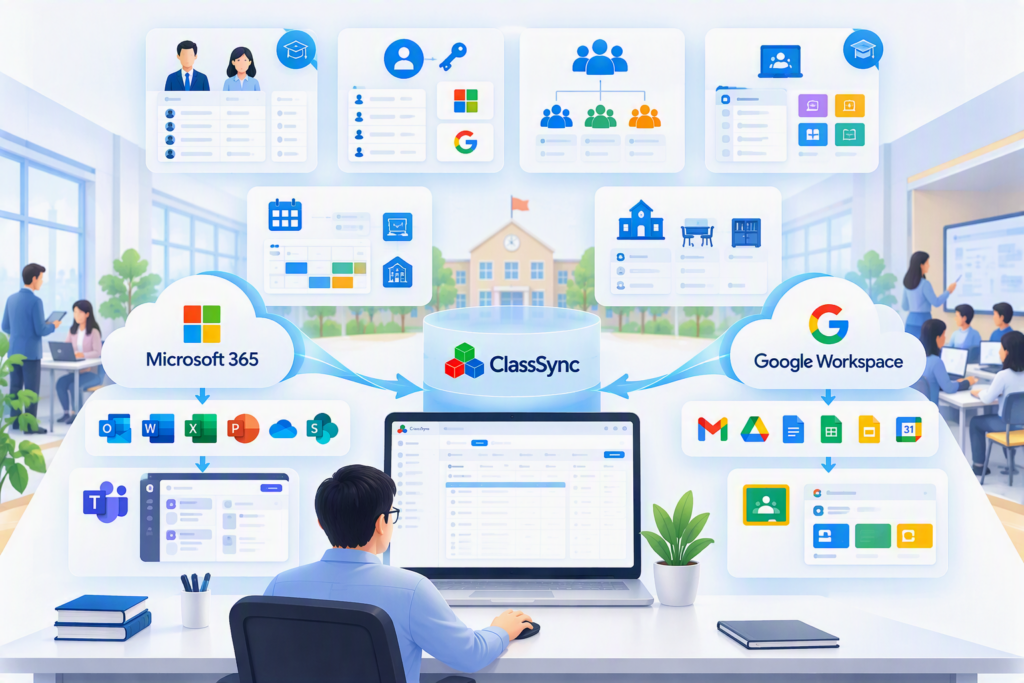
ClassSync can create and manage supported Microsoft 365 or Google Calendar™ events and school building, classroom, and resource information.
For supported school-information functions:
- schools in the Republic of Korea can use relevant information from the NEIS Education Information Open Portal;
- schools in Japan can use relevant school data from edu-data.jp; and
- schools in other countries can enter applicable school information directly.
SSO Account Provisioning
ClassSync supports account and user-attribute provisioning for schools that configure a SAML-based single sign-on environment between their Microsoft and Google environments.
Depending on the school’s identity architecture, Microsoft or Google identity technologies may be used as the Identity Provider (IdP).
ClassSync itself does not act as the Identity Provider or authentication service.
Instead, ClassSync helps standardize and maintain the corresponding school accounts and identifiers required for the school’s selected identity architecture.
This allows schools to use identity technologies already provided by Microsoft and Google without requiring ClassSync to operate another centralized identity platform.
Designed for Microsoft Teams and Google Classroom™
ClassSync is designed for schools that want the flexibility to use Microsoft Teams, Google Classroom™, or supported combinations of both.
Instead of tying teacher, student, class, and enrollment administration to one learning platform, ClassSync maintains a common local structure that can be reused for supported operations on either platform.
ClassSync provides the standardized local administration and provisioning layer. Microsoft and Google provide the identity, collaboration, classroom, and learning-platform services used by the school.
This approach is intended to make it easier for a school to select, combine, or change learning platforms without rebuilding its underlying roster-management process each time.
Rapid Deployment for Schools
ClassSync is a Windows client application.
An authorized school administrator can install ClassSync, prepare the school’s data locally, and use supported Microsoft 365 and Google Workspace™ APIs for applicable account, group, class, calendar, and resource-management operations.
The design goal is to provide a practical provisioning option without requiring DONGSEO to operate another centralized teacher-and-student roster platform.
This can be particularly useful for schools that want to use the cloud identity and learning services already provided by Microsoft and Google while keeping their primary ClassSync roster database under local administrative control.
Local-First Data Management
Teacher and student rosters are primarily stored on the administrator’s local device rather than in a DONGSEO-operated central roster repository.
When an administrator performs a supported management operation, information required for that operation is transmitted to the applicable Microsoft 365 or Google Workspace™ environment through authorized APIs.
Local School Data → Administrator-Initiated Operation → School-Managed Cloud Environment
This local-first architecture does not eliminate every security or privacy risk. Schools remain responsible for appropriately protecting administrator devices, local files, backups, cloud identities, administrator permissions, and their Microsoft 365 and Google Workspace environments.
For additional information, see ClassSync Local Data Storage.
ClassSync Mover
Cloud File Migration for School Transitions
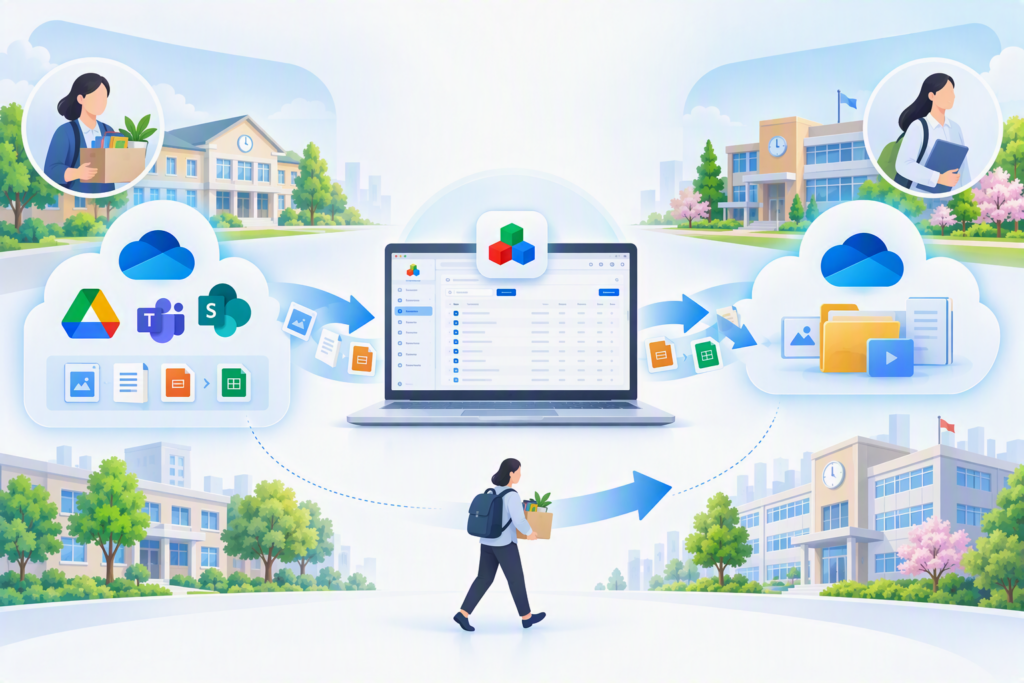
When authorized teachers or students move between schools, files that need to move may remain in an existing-school Google Drive™, OneDrive, Microsoft Teams, or SharePoint environment.
ClassSync includes a local cloud file-copying capability known as ClassSync Mover, also referred to as OneDrive Mover.
ClassSync Mover operates under the ClassSyncTeacher functionality and uses authentication and API permissions separate from the ClassSync administrator functionality.
Users can select supported files from an authorized previous-school Microsoft 365 or Google Workspace account and copy them through the local Windows device to a designated Microsoft 365 OneDrive account at the new school.
Source School Cloud → User’s Windows Device → Destination School OneDrive
Transferred file content is not stored on DONGSEO servers as an intermediary cloud-file repository.
Learn more about ClassSync Mover and cloud file copying.
Who Should Use ClassSync?
School IT Administrators and Technology Coordinators
Manage Microsoft 365 and Google Workspace™ accounts, groups, teacher and student rosters, classes, and supported education workflows using one locally managed school data source.
Schools Using Both Microsoft and Google Education Environments
Maintain a consistent account, OneID, group, class, and enrollment structure while using Microsoft Teams, Google Classroom™, or supported combinations of both.
Schools Preparing for a New Academic Term
Prepare or update teacher and student rosters, course assignments, enrollment rosters, groups, and classes before provisioning supported Microsoft and Google services.
Schools Looking for a Practical Provisioning Model
Use a Windows application and the school’s existing Microsoft 365 and Google Workspace cloud environments without requiring a separate DONGSEO-operated central teacher-and-student roster platform.
Teachers and Students Moving Between Schools
Use ClassSync Mover to copy authorized cloud files from supported previous-school accounts to a designated new-school Microsoft 365 OneDrive account.
ClassSync Capabilities at a Glance
| Capability | ClassSync Support |
|---|---|
| Local teacher and student roster management | Supported |
| Microsoft 365 account and group management | Supported |
| Google Workspace™ account and group management | Supported |
| ID Matching and ID Synchronization | Supported |
| OneID management | Supported |
| Google Workspace organizational-unit management | Supported |
| Microsoft 365 license management | Supported |
| Course assignments and enrollment rosters | Supported |
| ClassSync Teams Synchronization | Supported |
| Google Classroom™ synchronization | Supported |
| SDS V2.1 CSV file generation | Supported |
| Microsoft School Data Sync workflow support | Supported |
| Academic calendars and school resources | Supported |
| SAML-based SSO account provisioning | Supported |
| ClassSync Mover cloud file copying | Supported |
Availability and Deployment
Application: Windows client application
Distribution: Microsoft Store
Primary users: Authorized school administrators, IT staff, teachers, and supported ClassSync Mover users
Cloud environments: Microsoft 365 and Google Workspace™
School roster storage: Local ClassSync database
Class provisioning: SDS V2.1 CSV-based ClassSync Teams Sync, ClassSync Classroom Sync, and Microsoft School Data Sync workflows
International school information: Direct school-information entry is supported where a dedicated external school dataset is not used.
Frequently Asked Questions
Q1. What is ClassSync?
ClassSync is a Windows application that helps authorized school administrators manage locally maintained teacher and student rosters and use that school data for supported Microsoft 365 and Google Workspace™ account, group, class, enrollment, calendar, and resource-management operations.
Q2. Can ClassSync manage both Microsoft 365 and Google Workspace™?
Yes. ClassSync is designed to use the same locally managed school data for supported administration and provisioning operations across both environments.
Q3. Does ClassSync require a central ClassSync roster server?
No. Teacher and student rosters are primarily stored in the local ClassSync database on the administrator’s device rather than in a DONGSEO-operated central roster repository.
Q4. Does ClassSync replace Microsoft or Google identity services?
No. ClassSync does not act as the Identity Provider. It helps prepare and maintain supported accounts and identifiers required for the school’s selected Microsoft or Google identity architecture.
Q5. Does ClassSync support both Microsoft Teams and Google Classroom™?
Yes. ClassSync generates SDS V2.1 CSV data from locally managed school information and uses the generated data for supported ClassSync Teams Sync and ClassSync Classroom Sync workflows.
For Microsoft Teams, schools can use either supported ClassSync Teams Sync workflows or Microsoft School Data Sync according to their selected operating model.
Q6. Does Google Classroom™ synchronization use SDS V2.1 CSV data?
Yes. ClassSync Classroom Sync uses the SDS V2.1 CSV data generated by ClassSync as its school data source for supported Google Classroom™ class and enrollment synchronization.
The SDS V2.1 CSV data is generated from the locally managed Teacher Roster, Student Roster, Course Assignments, and Enrollment Rosters.
When those underlying records are updated, the SDS V2.1 CSV files should be regenerated before the affected Google Classroom™ classes are synchronized again.
Q7. What should I do after changing teacher, student, class, or enrollment information?
After the locally managed Teacher Roster, Student Roster, Course Assignments, or Enrollment Rosters are updated, regenerate the SDS V2.1 CSV files so that the generated data reflects the latest school information.
Then run the applicable provisioning workflow again:
- Microsoft School Data Sync: upload the newly generated SDS V2.1 CSV file set;
- ClassSync Teams Sync: select the affected class teams and run synchronization; or
- ClassSync Classroom Sync: select the affected classes and run synchronization.
Q8. Can ClassSync support an SSO environment?
ClassSync can provision and maintain supported account and user information used in a school-configured SAML-based SSO environment. Microsoft or Google identity technologies can be used according to the school’s identity architecture. ClassSync itself is not the IdP.
Q9. Can ClassSync help when users move to another school?
ClassSync Mover can help authorized users copy selected files from supported existing-school Microsoft 365 or Google Workspace accounts to a designated Microsoft 365 OneDrive account at the new school. File content is processed through the user’s local Windows device rather than through a DONGSEO-operated relay-storage repository.
Partner Experience in Education Technology
DONGSEO works with Microsoft and Google cloud technologies to support ClassSync deployment, account provisioning, school roster management, and education-platform integration.
Our partner experience reflects continued work with cloud identity, school roster, provisioning, and education technology used by schools.
Google Cloud Partner Network
Current partner designation shown above.
Microsoft Education Partner Recognition
Current Recognition
Issued by Microsoft Education (2026)
Previous Recognitions
Global Partner Program
ClassSync is looking for local partners who understand the education environment in their country or region and want to help schools adopt Microsoft 365, Google Workspace™, Microsoft Teams, Google Classroom™, and related ClassSync workflows.
Local partners can help bridge the gap between global cloud platforms and the language, school structure, support requirements, and deployment practices of each education market.
Depending on the agreed partnership model, collaboration may include:
- introducing ClassSync to schools and educational institutions;
- local product communication and market development;
- ClassSync installation and configuration support;
- customer onboarding and technical support;
- Microsoft 365 and Google Workspace™ environment configuration assistance;
- school roster and provisioning workflow support; and
- feedback on local education requirements and integration opportunities.
Our objective is to build long-term partnerships based on practical local support, sustainable cooperation, and shared growth.
If your organization supports schools, education technology, Microsoft 365, or Google Workspace™ and is interested in bringing ClassSync to your local market, we welcome the opportunity to work together.
Join Us as a Global Partner for ClassSync!
We are seeking partners worldwide to distribute ClassSync licenses and provide technical support. Let’s grow together in the global EdTech market.
Fair and Sustainable Collaboration for Shared Growth and Success